I returned yesterday from a 2-week long business trip to the US where I was reading and hearing media reports about the CWG debacle in Delhi; must say I had my head down in shame a bit. The Indian media perspective (more like "The Hindu's" perspective) is decidedly more mixed. Clearly it was top of mind for The Hindu with 7 stories on its Saturday's edition.
"Get your act together, Manmohan tells Ministers" - Where was he all these years?
"Sigh of relief for Games officials" - The said relief comes after a guardedly positive statement from the president of the CWG foundation, Mike Fennell. IOC president Jacques Rogge threw in his support as well. They both seem to believe things can still be salvaged in the next 8 days. Apparently a lot of progress has been made in the last 3 days.
"A letdown for a proud nation" writes Peter Roebuck the sometimes controversial British cricket writer. This article and another report I heard on the NPR reinforced the notion that there is at least some sentiment in the West that is rooting for India and these people are saddened by this setback to India's standing in the world. Among other things, Peter Roebuck cites some study about India that says in around 15 years, 291 million will move from poverty to a sustainable lifestyle and the size of the middle class will grow to 538 million. I wish I could believe that.
"Mixed reactions to facilities at the Village"
"Athletes village comes in for praise"
An Indian table tennis player actually liked the accommodations. Another Indian athlete opines anonymously that the facilities are 95 percent ready but the lack of finishing touch is making it look bad. A Kiwi player says they were promised world-class accommodations and was disappointed. The Kiwis however really liked the setup for table-tennis.
The final verdict will have to wait until after the games, but it is likely only to decide how black an eye India is going to get.
- Balaji
Saturday, September 25, 2010


Wednesday, July 14, 2010
Readings in history (part 5) - lecture by Dr. Parpola
During my last visit to Chennai, I attended a lecture by Prof. Asko Parpola, a well-known researcher on the Indus Valley Civilization (IVC) and the yet to be deciphered Indus script (see my earlier post on Harappans and Aryans). Prof. Parpola along with Dr. Iravaddam Mahadevan (another well-known researcher in this area) have hypothesized that the Indus script is a script used to write a proto-Dravidian language. Proto-Dravidian is the hypothetical language that Tamil and other Dravidian languages descended from.
In this specific talk, Prof. Parpola focused on a couple of possible connections between the Indus script and Dravidian languages. One was the preponderance of the "fish" symbol in the Indus script, some of which he claims to indicate a "star". Refering to a star as a fish is of course reminiscent of referring to a star as "Vin meen" in Tamil, where "meen" is Tamil for fish.
 The more elaborate discussion was on the occurrence of a symbol that is taken to be the hind-leg of the wild-ass, an inhabitant of the salt-deserts of north-west India (the same area where the Indus valley civilization had spread).
Prof. Parpola hypothesizes that the Tamil word for donkey "kaZhuthai" referred originally to the wild-ass as it can be parsed as "kazh" (salt-desert) + "uthai" (kick), i.e. kicker of salt-desert. He also conjectures that the old Tamil word "taal" (தாள்) which has multiple meanings including leg and star is another possible link.
Okay, if you're like me, you are probably thinking this is a big stretch. However, if there are multiple such tenuous links, I suppose they could add up to a "preponderance of evidence" claim.
In any case, the deciphering is very much incomplete as Profs. Parpola and Mahadevan readily admit and Prof. Parpola says other interpretations of these symbols are possible.
One unfortunate aspect of research like this is that it gets politicians and other people with vested interests and foregone conclusions all excited. The "Dravidians are great" gang understandably grasps at such research feverishly. (Prof. Parpola was an invited speaker at the recently concluded World Tamil Conference at Coimbatore where he was bestowed the 2009 Classical Tamil Award by Chief Minister M. Karunanidhi).
On the other side, the "Aryan supremacists" frown upon anything that gives the Dravidians any kind of legitimacy. For some of them, contesting this hypothesis is not just about denying the Dravidian connection to the IVC, but to appropriate an Aryan one (although there seems to be no archeological backing for the Aryan connection - there is plenty of evidence against it as John Keay talks about in his book).
There is however another school of thought (this by published scientists) that says that the Indus inscriptions were really not a script (of any language, Dravidian or otherwise), instead just a bunch of random signs (like a set of traffic signs).
The tension between the two sides (or is it three?) was apparent during the Q&A session after the talk.
Dr. Mahadevan alluded to this by asking the audience to limit themselves to "clarifying questions" on the paper. At a different point, Dr. Mahadevan (a Tamilian) also said that Dr. Parpola enjoyed some benefits as an IVC researcher that he himself did not have, because Dr. Parpola could not be labelled a "Tamil Chauvinist".
So, I was all prepared to witness some serious war of words, but it ended up fairly lame but for a couple of skeptical questions which Dr. Parpola answered rather diplomatically. I heard from my friend that an earlier talk by Dr. Parpola engendered a lot more debate.
Anyway, let us hope that this research is conducted solely by objective scientists with as minimal external influence as realistically possible. And I do hope they crack the script. Whether you consider yourself Aryan or Dravidian, the mystery of the IVC carries enough intrigue that you want to know the answers whichever way they point.
- R. Balaji
Related links:
An article in The Hindu on this topic
This blog post follows a robust debate on the merits of Parpola's ideas.
In this specific talk, Prof. Parpola focused on a couple of possible connections between the Indus script and Dravidian languages. One was the preponderance of the "fish" symbol in the Indus script, some of which he claims to indicate a "star". Refering to a star as a fish is of course reminiscent of referring to a star as "Vin meen" in Tamil, where "meen" is Tamil for fish.

Prof. Parpola hypothesizes that the Tamil word for donkey "kaZhuthai" referred originally to the wild-ass as it can be parsed as "kazh" (salt-desert) + "uthai" (kick), i.e. kicker of salt-desert. He also conjectures that the old Tamil word "taal" (தாள்) which has multiple meanings including leg and star is another possible link.
Okay, if you're like me, you are probably thinking this is a big stretch. However, if there are multiple such tenuous links, I suppose they could add up to a "preponderance of evidence" claim.
In any case, the deciphering is very much incomplete as Profs. Parpola and Mahadevan readily admit and Prof. Parpola says other interpretations of these symbols are possible.
One unfortunate aspect of research like this is that it gets politicians and other people with vested interests and foregone conclusions all excited. The "Dravidians are great" gang understandably grasps at such research feverishly. (Prof. Parpola was an invited speaker at the recently concluded World Tamil Conference at Coimbatore where he was bestowed the 2009 Classical Tamil Award by Chief Minister M. Karunanidhi).
On the other side, the "Aryan supremacists" frown upon anything that gives the Dravidians any kind of legitimacy. For some of them, contesting this hypothesis is not just about denying the Dravidian connection to the IVC, but to appropriate an Aryan one (although there seems to be no archeological backing for the Aryan connection - there is plenty of evidence against it as John Keay talks about in his book).
There is however another school of thought (this by published scientists) that says that the Indus inscriptions were really not a script (of any language, Dravidian or otherwise), instead just a bunch of random signs (like a set of traffic signs).
The tension between the two sides (or is it three?) was apparent during the Q&A session after the talk.
Dr. Mahadevan alluded to this by asking the audience to limit themselves to "clarifying questions" on the paper. At a different point, Dr. Mahadevan (a Tamilian) also said that Dr. Parpola enjoyed some benefits as an IVC researcher that he himself did not have, because Dr. Parpola could not be labelled a "Tamil Chauvinist".
So, I was all prepared to witness some serious war of words, but it ended up fairly lame but for a couple of skeptical questions which Dr. Parpola answered rather diplomatically. I heard from my friend that an earlier talk by Dr. Parpola engendered a lot more debate.
Anyway, let us hope that this research is conducted solely by objective scientists with as minimal external influence as realistically possible. And I do hope they crack the script. Whether you consider yourself Aryan or Dravidian, the mystery of the IVC carries enough intrigue that you want to know the answers whichever way they point.
- R. Balaji
Related links:
An article in The Hindu on this topic
This blog post follows a robust debate on the merits of Parpola's ideas.
Saturday, June 26, 2010
Historic visits - Kakatiya sites
We travelled to Warangal (140km from Hyderabad) and environs over the weekend to visit sites from the Kakatiya dynasty (13-14th century AD). Kakatiyas controlled northern Andhra Pradesh around that time and were feudatories of the Hoysalas of southern Karnataka. Their art definitely seems to have been influenced by their suzerains. Hoysalas of course built the famous temples of Belur and Halebid, arguably among the most beautiful sculptural temples of South India. I have visited Belur/Halebid as a kid but still remember some of the sculptural marvels.
Of the three places we visited
(I) the Kakatiya Fort complex in Warangal,
(II) the Ramappa temple in Palampet and (III) the temple complex (mostly in ruins) at Ghanpur,

I liked the Warangal site the most, probably because it was the most well maintained. There must have been a stunning temple here once. What you see now are various pieces of that temple that have been arranged into some kind of order by the Archeological Society of India (ASI). One of the prominent features were the perfectly circular inserts in the pillars that look as if they were lathed. Except they didn't have lathes in the 13th century.
 The scultptures show signs of systematic mutilation (right) suggesting that the temple was destroyed by an invading enemy. It is tempting to think of the Muslim invaders as the culprits - Malik Kafur, Ala-ud-din Khilji's general conquered these parts around that time. However my friend RG who accompanied me pointed out that vandalizing temples and monuments of a conquered kingdom was fairly common practice by kings of all religions throughout history. Wendy Doniger, noted Indologist whose "Hindus - An Alternative History" I am reading now, echoes similar sentiments.
 It was fun to have my friend who is an "amateur enthusiast" of sculptural art in South India play unofficial guide; we looked for various clues to identify the deities and other mythological characters portrayed there. For instance, two sculptures standing on either side of a small shrine turned out not to be Dwarapalakas as their position might suggest, but Lord Shiva himself, considering that he had 4 hands, wore an Angavastram that didn't go below the knee and the serpent earrings; clearly the re-arrangement of ASI still needs some work.
 The Ramappa temple was very curious in that it had a super-structure that was very much intact, while the base looked like it had been disturbed violently by an earthquake (picture to the right); or more likely because the temple settled into the ground that couldn't bear the weight of all that granite and basalt. The Ramappa temple had inscriptions that looked fairly close to modern-day Telugu script (I have picked up a little bit of the Telugu script in the last year, though I don't understand what I read).
 The temple complex at Ghanpur was in the worst shape. The highlights there were the leaning temples and the temples with fractal patterns in their vimanas (vimanas unlike gopurams are the towers over the main shrine; gopurams are at the gateway of the temple).
For more pictures from the trip, see this Picasa album.
Saturday, June 5, 2010
Life as a sports fan in India - Cricket, tennis and F1
For someone who was following the NBA, NFL, tennis and a bit of golf in the US, I needed replacements in addition to cricket and tennis in India. I love cricket, but there is just too much of it and you get saturated. I withdraw myself every few months, and come back to it refreshed.
I am on one such break now and I have discovered the joy of Formula 1. F1 features the most advanced and sexiest looking cars in the planet, super-talented egotistic young drivers with the maturity level of teenagers, challenging tracks (not the boring curved rectangles of NASCAR) and plenty of on-track strategy (pit stop, tyre and fuel strategy).
On top of this, the intra-team dynamics between the engineers and the two drivers creates lot of intrigue. Clearly it doesn't matter to the team which of their drivers wins as the total points from both contribute to the team's points for the Constructor's championship. However, the drivers are also after their individual glory of winning races and the annual driver's championship.
So what's not to love? There was one little problem. There was not much overtaking. Too often, it seemed like the car with pole position ran away for a coast-to-coast victory.
This season, they have tinkered with the rules and there is lots of overtaking - I don't yet understand which changes caused it. One significant change is the no-refuelling rule which means that there is no need for a "fuel strategy" . Fuel tanks have been enlarged to fill enough fuel to last the whole race. This implies that the cars get progressively faster as they consume fuel and get lighter through the race. The pit stops are now only for tyre changes (or to fix any number of issues that can crop up in the car) since tyres don't last the entire race. Fewer variables and simpler racing.
This year there are two teams (Red Bull Racing and McLaren Mercedes) that have the fastest cars and probably the four best drivers - Mark Webber and Sebastian Vettel for Red Bull; Lewis Hamilton and Jenson Button for McLaren. The Red Bull cars are faster in the corners, while the McLarens have better straight line speed. Any one of these 4 drivers can win on any given week. When one of these cars somehow falls behind in pole position or ends up behind because of a slower pit stop, they are certain to overtake everyone and come up front. Further there is a weekly battle within these four that makes for some seriously competitive racing.
Take for instance last week's Turkish Grand Prix. Webber and Vettel (the Red Bull drivers) were #1 and #2 going into lap no. 41 (it was a 58 lap race), when Vettel overtook Webber on the inside but inexplicably moved to the right, making contact. Vettel's car spun out of control and he retired from the race. Webber managed to rejoin the race as #3 behind Hamilton and Button (the McLaren drivers) who by now had taken the #1 and #2 spots. Vettel made a "mental" gesture as he walked out of his car, clearly blaming Webber for the incident even though the near-unanimous verdict from the pundits was that his move to the right (into Webber's way) caused the contact.
Then in lap 49, it was the McLaren drivers' turn for a duel. The McLaren crew radio-ed instructions to both drivers to "conserve fuel", so Hamilton slows down a notch; Button disregards the instructions, speeds up and overtakes a surprised Hamilton; Hamilton now furious, battles back and retakes the lead soon after. The McLaren crew is now in a panic as they don't want a repeat of what happened to the Red Bulls and repeat the instruction for conserving fuel, effectively asking them to stop dueling. The race ends with those track positions with Hamilton's first victory of the season.
As you can see from these videos, a lot of the action is now telecast with on-board cameras which is probably the best way to experience the race. I can't wait to watch this in HD when it does eventually come to India.
Talking of HD, Indian consumers have been getting conned into buying HD TVs for the last few years while there is no HD programming; finally Sun started HD service on some select channels (including coverage of this year's IPL) a couple of months ago. Tata Sky (which is what I have) promises to have it by end of year in time for the Commonwealth Games.
- Balaji
I am on one such break now and I have discovered the joy of Formula 1. F1 features the most advanced and sexiest looking cars in the planet, super-talented egotistic young drivers with the maturity level of teenagers, challenging tracks (not the boring curved rectangles of NASCAR) and plenty of on-track strategy (pit stop, tyre and fuel strategy).
On top of this, the intra-team dynamics between the engineers and the two drivers creates lot of intrigue. Clearly it doesn't matter to the team which of their drivers wins as the total points from both contribute to the team's points for the Constructor's championship. However, the drivers are also after their individual glory of winning races and the annual driver's championship.
So what's not to love? There was one little problem. There was not much overtaking. Too often, it seemed like the car with pole position ran away for a coast-to-coast victory.
This season, they have tinkered with the rules and there is lots of overtaking - I don't yet understand which changes caused it. One significant change is the no-refuelling rule which means that there is no need for a "fuel strategy" . Fuel tanks have been enlarged to fill enough fuel to last the whole race. This implies that the cars get progressively faster as they consume fuel and get lighter through the race. The pit stops are now only for tyre changes (or to fix any number of issues that can crop up in the car) since tyres don't last the entire race. Fewer variables and simpler racing.
This year there are two teams (Red Bull Racing and McLaren Mercedes) that have the fastest cars and probably the four best drivers - Mark Webber and Sebastian Vettel for Red Bull; Lewis Hamilton and Jenson Button for McLaren. The Red Bull cars are faster in the corners, while the McLarens have better straight line speed. Any one of these 4 drivers can win on any given week. When one of these cars somehow falls behind in pole position or ends up behind because of a slower pit stop, they are certain to overtake everyone and come up front. Further there is a weekly battle within these four that makes for some seriously competitive racing.
Take for instance last week's Turkish Grand Prix. Webber and Vettel (the Red Bull drivers) were #1 and #2 going into lap no. 41 (it was a 58 lap race), when Vettel overtook Webber on the inside but inexplicably moved to the right, making contact. Vettel's car spun out of control and he retired from the race. Webber managed to rejoin the race as #3 behind Hamilton and Button (the McLaren drivers) who by now had taken the #1 and #2 spots. Vettel made a "mental" gesture as he walked out of his car, clearly blaming Webber for the incident even though the near-unanimous verdict from the pundits was that his move to the right (into Webber's way) caused the contact.
Then in lap 49, it was the McLaren drivers' turn for a duel. The McLaren crew radio-ed instructions to both drivers to "conserve fuel", so Hamilton slows down a notch; Button disregards the instructions, speeds up and overtakes a surprised Hamilton; Hamilton now furious, battles back and retakes the lead soon after. The McLaren crew is now in a panic as they don't want a repeat of what happened to the Red Bulls and repeat the instruction for conserving fuel, effectively asking them to stop dueling. The race ends with those track positions with Hamilton's first victory of the season.
As you can see from these videos, a lot of the action is now telecast with on-board cameras which is probably the best way to experience the race. I can't wait to watch this in HD when it does eventually come to India.
Talking of HD, Indian consumers have been getting conned into buying HD TVs for the last few years while there is no HD programming; finally Sun started HD service on some select channels (including coverage of this year's IPL) a couple of months ago. Tata Sky (which is what I have) promises to have it by end of year in time for the Commonwealth Games.
- Balaji
Saturday, May 1, 2010
Trip to Mahabaleshwar
We went to Mahabaleshwar on a team outing - by over-night train from Hyderabad to Pune and then a bus ride to Mahabaleshwar. It is a "hill station" in the Western Ghats 100km from Pune. Hill station in quotes because at an altitude of 1400m, it is not as chilly as what you might expect like Ooty (2200m) or Kodaikanal (2100m).

 However it rivals if not exceeds the other two in terms of scenic beauty. It is situated on a plateau with stunning views of five river valleys all of which originate from near Mahabaleshwar. |Four of these are now dry, the fifth one being the still-wet Krishna. The Castle Rock and Arthur's Seat viewpoints offer views of canyons lined with stratified walls that are reminiscent of the great canyons of the US. Interestingly, the guide books (Frommer's, Lonely Planet) don't make a big deal of this. Goes to show how these places in India can be under-marketed also revealing attitudes towards tourism in India. The guides mention the temple adjoining the origin of the 5 rivers and the strawberry farms, but none the canyons.
- R. Balaji

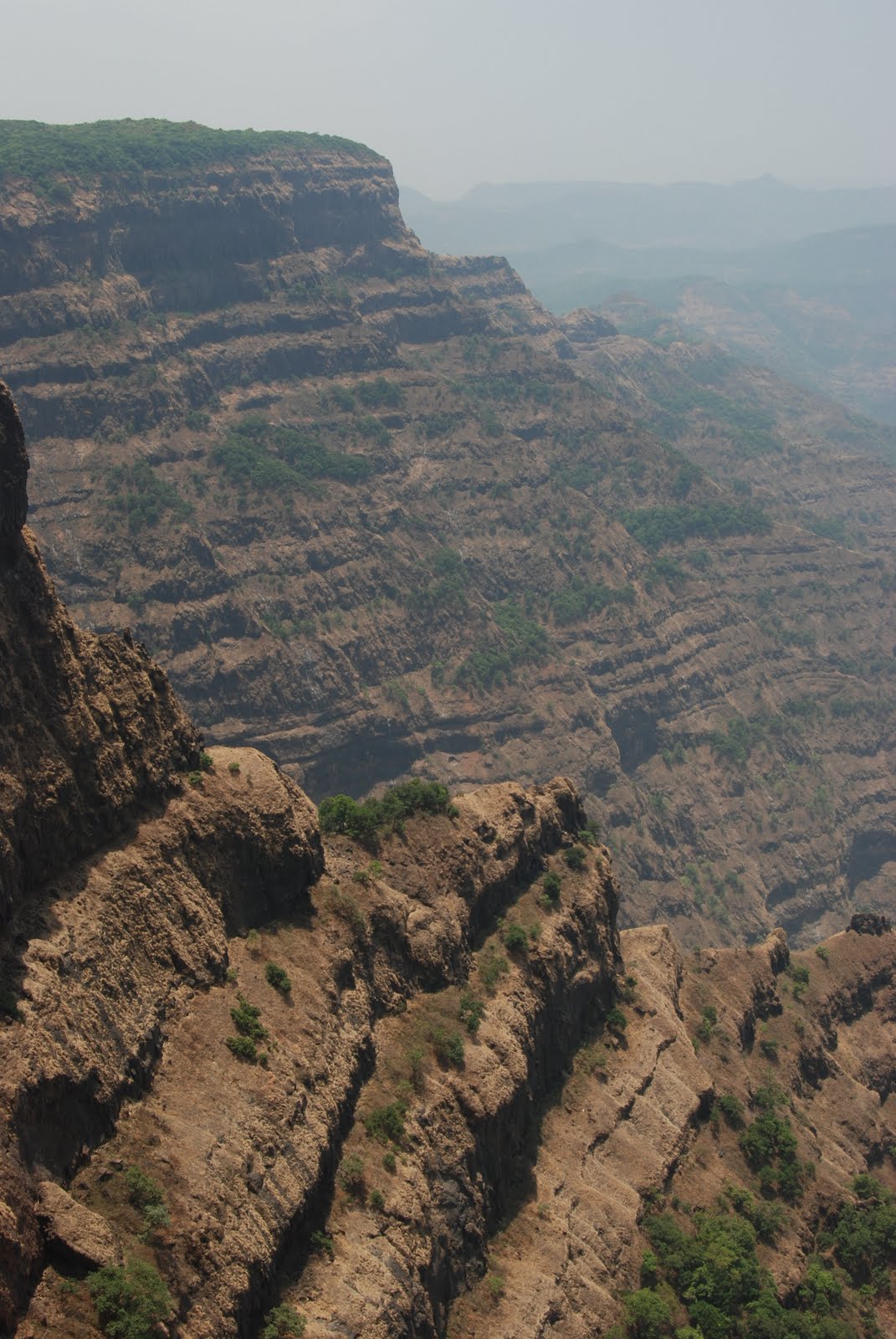 However it rivals if not exceeds the other two in terms of scenic beauty. It is situated on a plateau with stunning views of five river valleys all of which originate from near Mahabaleshwar. |Four of these are now dry, the fifth one being the still-wet Krishna. The Castle Rock and Arthur's Seat viewpoints offer views of canyons lined with stratified walls that are reminiscent of the great canyons of the US. Interestingly, the guide books (Frommer's, Lonely Planet) don't make a big deal of this. Goes to show how these places in India can be under-marketed also revealing attitudes towards tourism in India. The guides mention the temple adjoining the origin of the 5 rivers and the strawberry farms, but none the canyons.
 Friday, April 9, 2010
Golt movies ain't half bad
Okay, if "Golt" offends my Telugu brethren, I will invoke the Chetan Bhagat excuse - you only make fun of people who you care for.
It is now almost three years in Andhra Pradesh and what better way to get to know a people than to watch their movies? My wife and I have started watching Telugu movies on DVD borrowed from our neighbors. Going to the theater does not work because of the language problem, which is conveniently resolved with subtitles in the DVD form. And yes, my conclusion of this post's title was reached by a sample size of two - Magadheera and Arya 2.
When I was growing up, Chiranjeevi movies (dubbed in Tamil) used to be shown in the 10:30 morning show in my home town; I remember seeing trailers of these and feeling all superior about Tamil movies - the Chiranjeevi movies seemed like cheesy masalas even at that age. The only good Telugu movies seemed to be from K. Viswanath (Sankarabaranam, Sagara Sangamam, Swathi Muthyam etc.) at that time.
Fast forward 25 years (sheesh, I feel old writing that), and now Chiranjeevi's son Ramcharan is acting in masala movies, arguably much better ones. Magadheera was a super-hit last year and we could see why. It is a love-story that spans 400 years - a warrior and a princess from a pseudo-historical Deccan kingdom whose unfulfilled love gets another chance when they are reborn in modern-day Andhra (or is it Telengana?). Ramcharan is swashbuckling in the warrior role and passable in his modern day incarnation while Kajal Agarwal pulls off both roles with aplomb (aside from looking cute beyond belief); my wife's assessment of the two actors might be the reverse.
It amazes me how little the Indian film industry dips into our vast and rich history for its stories these days. I can't remember a single recent movie set in pre-colonial India other than Jodha Akbar and Ashoka (both laudable efforts). Movies like Magadheera show the possibilities even though this one is actually not based on historical events.
Indian movies have made enormous progress in photography, art direction and other technical areas. I think it is about time big-budget producers and directors made some blockbusters set in our history.
Anyway, coming back to Magadheera, it should show Tamil masala directors a trick or two. I now see why a lot of recent masala hits (the Vijay ones especially) are being imported from Telugu to Tamil.
A lot of the movie is shot in Hyderabad and it was fun to see some places that we know. I have been to the Golkonda fort many times; it is a great place especially when you see it with a guide who can put it in the right historical context. But it never looked as beautiful as it looked in Senthil Kumar's camera in the song "Panchdhara Bomma". The song alone is worth the price of admission. It is arguable whether India produces world-class movies, but we sure make the world's best music videos.
The other movie Arya 2 was more of a guilty pleasure. The movie is outrageously campy but it was also very funny. Boy, this guy Allu Arjun can dance (and I thought Vijay could dance).
- R. Balaji
It is now almost three years in Andhra Pradesh and what better way to get to know a people than to watch their movies? My wife and I have started watching Telugu movies on DVD borrowed from our neighbors. Going to the theater does not work because of the language problem, which is conveniently resolved with subtitles in the DVD form. And yes, my conclusion of this post's title was reached by a sample size of two - Magadheera and Arya 2.
When I was growing up, Chiranjeevi movies (dubbed in Tamil) used to be shown in the 10:30 morning show in my home town; I remember seeing trailers of these and feeling all superior about Tamil movies - the Chiranjeevi movies seemed like cheesy masalas even at that age. The only good Telugu movies seemed to be from K. Viswanath (Sankarabaranam, Sagara Sangamam, Swathi Muthyam etc.) at that time.
Fast forward 25 years (sheesh, I feel old writing that), and now Chiranjeevi's son Ramcharan is acting in masala movies, arguably much better ones. Magadheera was a super-hit last year and we could see why. It is a love-story that spans 400 years - a warrior and a princess from a pseudo-historical Deccan kingdom whose unfulfilled love gets another chance when they are reborn in modern-day Andhra (or is it Telengana?). Ramcharan is swashbuckling in the warrior role and passable in his modern day incarnation while Kajal Agarwal pulls off both roles with aplomb (aside from looking cute beyond belief); my wife's assessment of the two actors might be the reverse.
It amazes me how little the Indian film industry dips into our vast and rich history for its stories these days. I can't remember a single recent movie set in pre-colonial India other than Jodha Akbar and Ashoka (both laudable efforts). Movies like Magadheera show the possibilities even though this one is actually not based on historical events.
Indian movies have made enormous progress in photography, art direction and other technical areas. I think it is about time big-budget producers and directors made some blockbusters set in our history.
Anyway, coming back to Magadheera, it should show Tamil masala directors a trick or two. I now see why a lot of recent masala hits (the Vijay ones especially) are being imported from Telugu to Tamil.
A lot of the movie is shot in Hyderabad and it was fun to see some places that we know. I have been to the Golkonda fort many times; it is a great place especially when you see it with a guide who can put it in the right historical context. But it never looked as beautiful as it looked in Senthil Kumar's camera in the song "Panchdhara Bomma". The song alone is worth the price of admission. It is arguable whether India produces world-class movies, but we sure make the world's best music videos.
The other movie Arya 2 was more of a guilty pleasure. The movie is outrageously campy but it was also very funny. Boy, this guy Allu Arjun can dance (and I thought Vijay could dance).
- R. Balaji
Saturday, March 13, 2010
He did it!
One of the issues I have continued to follow after I returned from the US is health care. I have also been following how Obama is doing as president. It was a no-brainer to vote for him being on the center-left myself, especially after the Bush years. While I knew expectations on him were wildly unrealistic, I was still hoping for say just a couple of miracles.
However, in the first year he had managed to disillusion everyone who voted for him and enraged everyone who did not. The health care debate was going badly for the Democrats with Republicans managing to vilify it quite effectively. So when I went to the US for my quarterly business trip in February, I was in a morose mood. I was especially disgusted by how the loss of one senate seat could make Obama and the Dems so timid (filibuster, schmilibuster).
However there were signs of a turnaround in those two weeks I was there. When the history is written about how Obama pulled off a legislative achievement that could very well rank among FDR's New Deal, the Reagan tax cuts and LBJ's civil rights bill, the healthcare summit should be judged as a turning point. It was political theater at its best, seemingly orchestrated only for the O man's benefit. He seemed like the only adult in the room, and just couldn't help coming across as the most intelligent and knowledgeable on the issues. He also came off as gracious in accepting a couple of Republican ideas and in a hilarious moment acknowledged the feisty John McCain's criticism about some pork barrel in the bill.
Since then, the Democrats (led by the formidable Nanci Pelosi) seemed to have new energy infused into them and for once have acted with the courage of their convictions. The Dems in the House are passing a bill that is supposedly unpopular (depending on what polls you believe) and might even cost some of them their seats in November. Why? Because they believe it is the right thing. Where were they all these years? Looks like there is some hope for them after all.
So why do I think this bill is a good thing ? There is a part of the bill that spends money to cover un-insured and under-insured people*. I support this part for the same reasons why most bleeding heart liberals do. Don't get me wrong - capitalism is the greatest thing since steamed idlis, but there are a couple of things for which we should make an exception. Health care is one of them.
Then there is the part that prohibits insurance companies from doing plain old shady things - like stopping coverage once you get sick and deny coverage for pre-existing conditions ( the latter is arguably less shady). The fact that profit-minded companies will do things like these (can't even blame them), is exactly why we need to exempt health care from capitalism and free markets. And why it is reasonable for a social justice minded government to get into this business.
There is a supposed third goal of this bill that reduces the upward spiral of health care costs. The problem is real enough (US spends the most per capita on health care in the world, while it is not in the top 15 nations in terms of health indicators). But this part seems so complicated that we will never know until we see some results.
- R. Balaji
However, in the first year he had managed to disillusion everyone who voted for him and enraged everyone who did not. The health care debate was going badly for the Democrats with Republicans managing to vilify it quite effectively. So when I went to the US for my quarterly business trip in February, I was in a morose mood. I was especially disgusted by how the loss of one senate seat could make Obama and the Dems so timid (filibuster, schmilibuster).
However there were signs of a turnaround in those two weeks I was there. When the history is written about how Obama pulled off a legislative achievement that could very well rank among FDR's New Deal, the Reagan tax cuts and LBJ's civil rights bill, the healthcare summit should be judged as a turning point. It was political theater at its best, seemingly orchestrated only for the O man's benefit. He seemed like the only adult in the room, and just couldn't help coming across as the most intelligent and knowledgeable on the issues. He also came off as gracious in accepting a couple of Republican ideas and in a hilarious moment acknowledged the feisty John McCain's criticism about some pork barrel in the bill.
Since then, the Democrats (led by the formidable Nanci Pelosi) seemed to have new energy infused into them and for once have acted with the courage of their convictions. The Dems in the House are passing a bill that is supposedly unpopular (depending on what polls you believe) and might even cost some of them their seats in November. Why? Because they believe it is the right thing. Where were they all these years? Looks like there is some hope for them after all.
So why do I think this bill is a good thing ? There is a part of the bill that spends money to cover un-insured and under-insured people*. I support this part for the same reasons why most bleeding heart liberals do. Don't get me wrong - capitalism is the greatest thing since steamed idlis, but there are a couple of things for which we should make an exception. Health care is one of them.
Then there is the part that prohibits insurance companies from doing plain old shady things - like stopping coverage once you get sick and deny coverage for pre-existing conditions ( the latter is arguably less shady). The fact that profit-minded companies will do things like these (can't even blame them), is exactly why we need to exempt health care from capitalism and free markets. And why it is reasonable for a social justice minded government to get into this business.
There is a supposed third goal of this bill that reduces the upward spiral of health care costs. The problem is real enough (US spends the most per capita on health care in the world, while it is not in the top 15 nations in terms of health indicators). But this part seems so complicated that we will never know until we see some results.
- R. Balaji
Subscribe to:
Posts (Atom)