Thursday, November 8, 2018

Trip to Kanchipuram - Kailasanathar Temple

We traveled to Kanchipuram on a day trip from Chennai. I was lucky to have my friend who is a learned historian, well versed in Pallava architecture and iconography. To warm things up, we went to a couple of smaller temples first (Mukteswara temple, Pravalavarna Swamy Temple) before lunch at Hotel Sakthi Ganapathy, followed by a 3 hour stop at the highlight of the visit - the Kailasanathar Temple.

Kanchipuram can stake a claim to be the temple capital of South India, if not all of India. The Pallavas ruled from here during the 6th, 7th and 8th centuries CE and have commissioned temples of breathtaking majesty, whose sculptural  and architectural excellence make them in my humble opinion on par with that dynasty's efforts at Mamallapuram.  UNESCO which bestowed World Heritage Site status to Mamallapuram, for some reason has given the Kanchipuram temples a miss. 


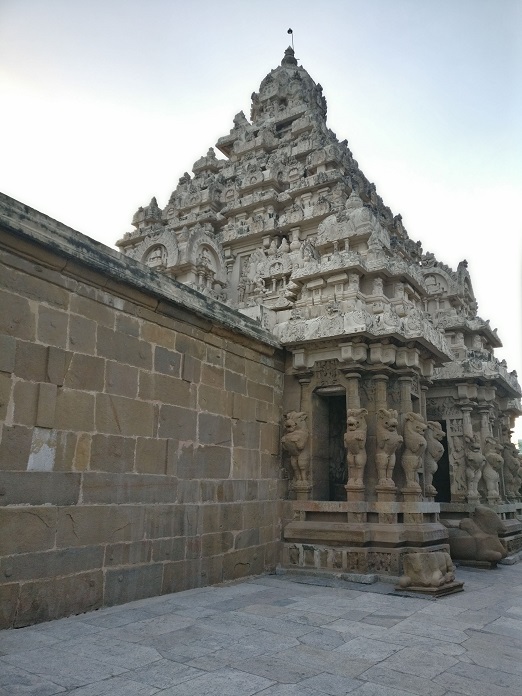
The Kailasanathar temple was commissioned by Rajasimha Pallava who is also credited with the Shore Temple at Mamallapuram. The vimanam (structure on top of the inner sanctum) is reminiscent of the Mamallapuram Shore Temple although much bigger. The vimanam and most of the superstructure is built of sandstone on a granite base. The Vijayanagar kings are said to have added the granite mandapam (hall) that connects the main temple to the original Pallava mandapam. I think they did a disservice which among other things, robs one off a more complete view of the beautiful main temple.

The temple is structural in the sense that it is made of a stack of sandstones, with the sculptures spanning and aligned across multiple stone pieces. See adjoining picture of Dakshinamurthy where you can see the crease line between the stones along the forehead of the elephant and along Dakshinamurthy's waist.

The unique architectural feature of the temple is the surrounding structure which is made up of 58 sub-shrines with exquisite sculptures both inside and between them. The sculptures depict Lord Shiva in his many forms, along with other figures of the Hindu Pantheon playing out scenes of stories from the puranas and other Hindu texts:

Gangadhara, where Shiva gathers the river Ganges with a strand of his hair. Parvathi in a twisted pose seems to be looking with a touch of envy.

Dakshinamurthy under a banyan tree surrounded by peaceful lions, deer and the rishis receiving his silent intonation of the vedas.

Dancing as Urdhwa Tandava where he is raising one of his legs almost vertically up to replace his fallen ear rings (kundalam) without missing a step (there is a legend that Shiva and Parvati were dancing in competition and Parvati could not match this particular move, understandably so, owing to her modesty). This pose is the second most common pose of Shiva dancing in Pallava and Chola art, with Nataraja being of course the more common and well known.

Lingodbhava, where Vishnu and Brahma are trying in vain to find Shiva's feet and head respectively.

Kalantaka, where Shiva is rescuing his devotee Markandeya from Lord Yama.

Kirata & Arjuna showing Arjuna and Lord Shiva as Kirata the hunter dueling before Shiva grants Arjuna his astras for the Mahabharata war.

In addition to Shiva, Vishnu also figures in some of the sculptures, the most common form depicted being the Narasimha.

There are Tamil inscriptions (in the Grantha script) along the bottom of the sculptures citing the many titles Rajasimha presumably bestowed upon himself  including ironically Guna Vineetha  - the humble one. There are two layers of inscriptions the bottom one a beautiful calligraphic version (see picture).

In the niches between the subshrines you see Somaskandhas - Shiva, Parvati seated with Karthikeya as a child between them and also a couple which is likely to be Rajasimha and his queen or Siva and Parvati. The case for the former is strengthened by the fact that the couple don't have their hands in the abhaya (blessing) mudra.

It should be noted that the iconography is not always obvious and the two experts who I was with sometimes had different interpretations of some of the sculptures. One such sculpture is remarkable for the dynamism in the poses of the figures is (arguably) a scene where Indra is trying to enter Kailasha but is stopped by a Gana*. There is something unique about this Gana, who is bigger and standing on a lotus which should have given Indra a clue. Indra, angered by the rebuff is about to deploy his Vajrayudha, while Brahma is desperately trying to stop him, having realized that the Gana is none other than Shiva himself.

I reached information overload and we had finished only two sides of the outer sub-shrine lined structure. After coffee and snacks at Saravana Bhavan, we made a quick stop at the Pandava Thoothar Perumal Temple that houses a gigantic form of Lord Krishna. He assumed this when Duryodhana tried to humiliate him when he came to visit as the Pandavas' messenger trying to stop the war. The bigger black statue is actually behind the Utsava Murthy (idol used during processions) in the inner sanctum.

It would take at least a week to do justice to all the major temples of Kanchipuram. We looked at the majestic gopuram of Ekambareswarar Temple from the distance. Not to mention Vaikunta Perumal, Kamakshi Amman, Ulagalantha Perumal to round out the top 5.

- Balaji


* Gana's are Shiva's attendants in Kailasha who are often portrayed as dancing, sometimes with musical instruments. They are also gatekeepers and are notorious for their protectiveness of Shiva's valuable time.

Saturday, March 17, 2018

Thousand paper cuts

I have been meaning to write about the small irritants that we face every day as we commute back and forth to work and live our daily lives in ever more crowded metropolises. A lot of them, I realize, are avoidable, but we inflict them upon ourselves. They are community or government imposed restraints or misguided mitigations that could have been avoided in the first place if everyone followed rules and played nice. The problem with this is that the behaviors of the minority who are rule violators cause everyone to pay a penalty.

I will start with the ubiquitous speed breaker. When our residential community was built 8 years ago, we didn't have any speed breakers. After noticing how fast people were driving inside the community even after repeated exhortations, the community decided to put in speed breakers. This is a localized example of a phenomenon we see everywhere on public roads. Because people speed, the authorities think speed breakers are the only way to slow them down thereby penalizing drivers that drive responsibly with harsh thuds that cause just a tiny amount of degenerative change in your backbone every time. This I am sure has caused totally unintended consequences. People believe they can speed as much as they want until they are signaled by their authorities to slow down through the presence of a speed breaker. The effect of such speed breakers and the ever present potholes on Indian roads have caused car makers to build vehicles with higher and higher road clearance and often advertise it as a great feature.

I don't know why we need to ride or drive with high beam inside the city where there is plenty of ambient light. I am continuously blinded by them and I am sure I am not the only one who cannot see a pedestrian wearing dark clothes to the left of the oncoming car until the last desperate moment. I have tried playing traffic vigilante, flashing my lights at the oncoming car. One in ten cars get the hint and dim their lights perfunctorily. The authorities not only seem to ignore this problem, they actually accommodate for it; they build partitions between the two sides of the road and increased the height just enough to hide the headlights of cars coming from the opposing side. Car manufacturers have tried to mitigate the problem by manual or auto-dimmers in rear view mirrors.

This problem with high beams had an interesting ripple effect in my community. The security guards at the gates of my community like to look at the driver of an approaching car to see if it is a known inhabitant or a visitor and act accordingly. With the high beam this is simply impossible, so they decided to fight light pollution with more light pollution. They worked with the community officials to install bright LED lights facing the oncoming cars. This meant that the security area is lit up like a studio throughout the night; light that seeps into neighboring houses including mine.

I can go on. I see a similar phenomenon with security (either cyber or physical security), wherein in the name of security we have added inconvenience after inconvenience and we numbed ourselves to them as the new normal; my favorite example is flying in an airplane. This is a bit more controversial and a topic for another day.

R. Balaji

Saturday, January 9, 2016

The Bronze Gallery at the Government Museum, Chennai - part 1 (long)

During my end of the year trip to Chennai, I got to attend a few cultural events (Carnatic Music, Bharata Natyam) and ended the trip with a guided tour of the Bronze Gallery at the Madras Museum. The tour was a highlight since it was guided by none other than Dr. Chithra Madhavan, noted historian who seems to be among other things an expert of bronze art of South India. The gallery is remarkable as it houses examples of metal art undoubtedly at its finest, especially those from the Later Chola period (10th-12th centuries CE). Cholas seem to be to bronze, what Pallavas were to granite. Of course, attributing authorship to a dynasty is doing grave injustice to the artisans who actually did the work, be it at Mamallapuram or here. However, the expenses and massive effort required, the consistency of pattern (more technically, iconography) and style across multiple statues unearthed from places that are 100s of kilometers apart, suggests a central and prosperous entity that sponsored it. I am sure there is other evidence linking it to the Cholas, I just don't remember hearing it during the tour. 

Dr. Chithra walked us through how the statues were made (the Lost Wax method) and described them with great detail, passion, flavored by her own personal insights and opinions. This is an attempt to faithfully record my experience and any omissions or misstatements are entirely because of my poor listening skills. 

The gallery consists of three floors, the ground flood dedicated for Saivite art, the first for Vaishnavite, and the second for Buddhist/Jain specimens.

How they were made
The actual sculpting happens using beeswax with which the statue (the level of detailing includes the finger and toe nails of the deity) is first made. Then they used clay of a certain quality that is from the Cauvery basin (even today, the bronze sculptural art thrives in towns on the banks of Cauvery like Kumbakonam) to make the mold surrounding the beeswax. After the clay mold dries, they heat the wax and melt it out. Now the mold is ready to pour the molten metal into it - be it bronze or if you had the resources, gold.

It is believed that they may have done finer detailing - like in the jewellery - after the mold was broken. At this point it is a statue. Making it a deity to be put into a shrine or as a Utsava Murthy in a procession, there is an elaborate ritual that has to be completed. The end of this ritual involves putting a mirror in front of the statue and the pupil in the eye is carved out, so that the God looks at himself as the first sight when he opens his eyes.

It is believed that the Hindu sculptures followed the rules written down in the Agama Shastras and the Shilpa Shastra. This doesn't constrain the creative expression of the sculptor. The finest examples (mostly from the Chola period) sport a delicate pose with perfect iconometry (perfect proportions) and the faces often sport a smile; things that no rule book can possibly teach. I honestly can't imagine how you carve a smile on a face. 

How they were found
Many of the Hindu bronze statutes were found near temples, often dug up from the earth or from water bodies (the temple Theppakulam or a nearby well). It is believed that when the invaders came, the priests tried to hide the idols by throwing into the water body or buried it near the temple. In some cases, the priests may have returned and reinstalled the deities, but in other cases, were killed or for whatever reason never came back. The idols were later found in the last 2 centuries by chance when someone was cleaning the theppakkulam or if it dried out.

The iconography  
When the idols are found, you of course don't find a label conveniently next to it, so the very interesting problem of identifying the god or mythological figure depicted comes up. As per Wikipedia, iconography is the branch of art history that deals with the identification, description and interpretation of the content of historic artifacts (Robert Langdon of the Dan Brown series was an iconographer). To me, this was the coolest part. You identify the deities based on the weapons they carry, their garments and sometimes their pose. Lord Shiva is portrayed with 4 hands, two of which carry an axe and a doe. The doe represents the human mind that darts about wildly and him holding it represents the control of the mind. The pose of the other two arms depends on which form of Shiva is portrayed. One of my favorite forms is the Tripurantaka. As per the legend, Shiva kills the three sons of Tarakasura using a single arrow. In this form, he proudly wields the bow (except the bow is not part of the statue - it definitely cannot be made as part of the same mold). The bow may have been made and attached separately. But the idols in the museum showed no sign of this. In any case, the way you identify Tripurantaka is how Shiva's left arm is held high up as if he would be holding the bow at its top. To make things interesting, there is another form of Shiva in the museum which is clearly a form of Shiva because of the doe and the axe. However his left arm is a little lower and the right arm is even lower  and the fingers are in a position as if they are strumming a string instrument. This is Shiva holding a Veena in the form of Dakshinamurthy. There are only subtle differences between Tripurantaka and Dakshinamurthy. Then there is Adhikara Nandhi who looks like Shiva in that he is holding the doe and the axe. But we know he cannot be Shiva because his hands are in a supplicative posture of the bhakta, in this case Nandhi in human form.There are also the nayanmars, notably Appar who has a distinct ring of beads on his head and a very finely detailed angavashtram.

At the far end of the gallery, is a stunning large Nataraja. The circular framing you see around Nataraja is called a prabha. The other well known prabha is the one around Lord Venkatachalapathy in Tiruppathi (or Hyderabad's own Birla Mandir). The flames you see around Nataraja's prabha (typically 27 in number) represent the 27 nakshatras and the circle holding them represents the cosmos. Shiva's pose is of course well known for its majesty, his hair flaying in both directions as he swirls, his left arm pointing to his crossed left foot asking for the soul to surrender at his feet and his right arm in the blessing mudra. The other stunning idol is that of the Ardhanari, where the difference in between the shape of the shoulders between the male and female sides and the hair on the back  are remarkable (Shiva's jata mudi is actually longer than Parvati's half).

The 1st floor holds Vaishnavite work. Vishnu is portrayed with the Sudarshana Chakra and the Conch (shanku). As for the front arms, the left one is down as if holding a mace.  There is one rare piece where the chakra is in prayogachakra form, ready to be deployed, turned 90 degrees with the sharp edge facing the enemy. Since we spent more time on the Saivite gallery, and I reached information overload by the time we reached there, I am not going to do justice in this entry. Hope to go there again with more focus on the 1st and 2nd floors.

The Bronze gallery is perhaps 1/10th of the museum and we spent a good 2 hours on it. It is amazing how we don't pay attention to a place (the Chennai Museum) right under our nose and travel all around the world looking for fine art. I know I will not look at any sculpture (bronze or granite) the same way again, looking for the various elements trying to identify the god and the elements to look for artistic excellence.

R. Balaji

Saturday, December 12, 2015

Farewell Jon Stewart


A bit out of date, still wanted to re-post what I wrote in FB a few months ago.

http://www.nytimes.com/…/jon-stewart-a-sarcastic-critic-of-…
I am sure this article does a much better job, but I wanted to do my own eulogy of Jon Stewart's departure from Comedy Central's Daily Show.
I am depressed; not that I have been able to watch a lot of him these days from India and especially when I am jaded about American politics. When I started watching him (more than 10 years ago?) he blew my mind away. Behind the humor (mostly good but at times crass) and silliness, there was a very intelligent political satire. He brought some refreshingly new templates to the game of political satire. Exposing politicians' and the media's hypocrisy by juxtaposing what they are saying now with what they said a couple of years ago. 

His targets were not just politicians, but also mainstream media (CNN), the political right and of course his arch enemy Fox News. He has had multiple famous exchanges with Bill O'Reilly from Fox News, with each appearing on the others' shows. There is general consensus that Jon won most if not all of those debates. But you also got the sense that they had some grudging respect for each other. Another great format is his reporters giving fake news reports from a "remote place" (while they are clearly standing on another corner of the studio). There are also actual reports produced with tongue in cheek interviews which Jim Colbert was great at before he left the show. 

During the last Indian elections, there was a 5-part report which was absolutely hilarious; it balanced multiple things - backhanded compliments and respect to the massive Indian election machinery including the 100 % electronic voting (which incidentally the US still doesn't have) and of course lots of fun at the expense of some hapless bureaucrats. Like any great entertainer, Jon has groomed a lot of talent that has left his show and started their own very successful shows - Jim Colbert's Colbert Report (pronounced of course as Colbeir Repor) and more recently John Oliver's Last Week Tonight.

I am sure most people on the right side of the political spectrum hate him, often with good reason. But I am sure they wish they had someone intelligent like him on their side (to complement the perennially angry loudmouths they have). His political bias did not stop prominent figures from the right from eagerly lining up to come to his show; his show had huge ratings and any kind of visibility can't hurt; he would invite the more reasonable people and I thought he generally treated them with due respect - I remember a very civilized interview with Mike Huckabee on abortion.
Oh well, this is definitely an end of an era. Will miss you Jon.

Friday, September 18, 2015

Fender benders and street justice


I wrote this a while ago, but didn't feel like posting. Now I am in a blogging mood, so publishing it finally.

One of the maddening things about India is of course how the roads are and how we all drive on them. It is my 8th year since my return and this is one of the things that still irks me. I used to find Hyderabadis' road manners especially bad, perhaps because Hyderabad roads still seemed to have some space (compared to say Bangalore and Chennai) for people to misbehave. That is changing in the last 7 years, as Hyderabad roads have become more and more congested. I am not as bothered by my fellow drivers on the roads these days, and I am wondering if this is because my driving has deteriorated to that level.  I have had my share of accidents; with god's grace no injuries to body, but my cars have taken a lot of punishment; and I have inflicted some as well. Recently I seem to be going through a stretch of bad luck with three fender benders in the last four months or so.

In the US, after an accident, there is a fairly organized process of blame assignment and financial recovery through insurance.What happens after a fender bender in India can be quite chaotic.   At least so it would appear for the lay observer. I routinely see altercations which at times escalate to fisticuffs. Once my driver got into one of these with an auto driver; it was a blur, but I remember forcibly removing him from the melee. In the more civilized encounters (as I can attest to based on personal experience ) there is a certain kind of spontaneous street justice.  Things are happening fast with all the people involved clearly worked up and witnesses gather to weigh in on the matter. If you're a participant, you have to make some split second decisions factoring in all of this.

The first two accidents were on my commute returning home. In the first one, a cyclist with a pillion rider came very fast on an intersection and hit me on the side. In intersections, everyone assumes they have full right of way and come full speed and this happens millions of times every day miraculously without incident. On this occasion it didn't. I believe I was right to assume I was on the "major" road and the other was a smaller street. The bicyclist had fallen down just ahead of me and I motioned to him that I am going to cross the intersection but will stop after that. I pulled up and got down. The driver of an SUV behind me came up, rolled down his window and helpfully pointed out that it was clearly not my fault and I didn't need to stop. I stopped anyway. The cyclist and his rider were not injured but his front wheel was a bit bent out of shape. The cyclist who seemed not older than 18 made some vague complaining noises but I thought his heart was not in it. Another pedestrian started scolding the bicyclist (in Telugu if I remember right) that I couldn't entirely follow. I decided I was clearly not at fault, said something to the cyclist to that effect and bailed.

In the second one, I received a call on my way home which caused me to change my plans and make a U-turn. I swung a bit left to turn right so that I could make the U-turn within the narrow street. As I was turning I noticed a bike on my side mirror; I thought he would be able to swerve away and continued through my turn. He clearly was coming too fast. He barely avoided contact with my car but fell down. Again I stopped and walked over. He seemed shaken up with his helmet at an odd angle, but thankfully unhurt. He seemed unsure whether to be aggressive with me. Again things were a blur, but I remember him pointing to his brake wire which had come off. A bystander joined him and made sympathetic noises. I decided I was at least partially at fault in making a sudden U-turn. My slight left turn before the right turn might have confused him even though I had the right indicator on. I told him he was coming fast, but I will pay for his brake wire damage and gave him Rs. 1000. The guy actually thanked me! I turned around and left.

A few days later on the day of Holi, we heard a crash outside our house, bud didn't think much of it until someone knocked on our door. Someone had backed in and crashed into my trusty old Honda Civic. My neighbors told me they saw who did it (another neighbor); he was drunk and will pay for it. He later stopped by and apologized profusely and agreed to pay up and he did after I showed him the receipts from the Honda body shop.

A few things that stood out for me in all this  - the collective fairness of the street justice; for the most part the impressions of the bystanders actually helped me decide (or confirm my instinct) as to my course of action. The innocence and integrity of the victim of the last one with the brake wire damage. And most of all this is clearly an example of order in chaos that people mention when they talk about India.

Balaji


On learning languages and scripts - part I

After moving back to India, living in Hyderabad, I used Hindi for practical purposes for the first time. I learnt Hindi as a school going kid with a private teacher in my home town Kovilpatti and passed many of the Dakshin Bharat Hindi Prachar Sabha exams. All the way till Praveen Purvardh (had to leave Utharardh for post retirement). I think 12th standard intervened. The syllabus gets quite up there once you get to Vishaarad including studying a bunch of Hindi literature. I remember studying Tulsi ke dohe, Panchavati (portion or Ramayana from a poet whose name I don't remember) among others. The one I fondly remember is the short stories and novellas by Munshi Premchand. His stories were of the simple and soul stirring variety.

Ironically, I didn't use my "knowledge" until I returned to Hyderabad 22 years later. Whether you know Telugu or not, you can survive with Hindi in Hyderabad. For the most part. It was pointed out that what is spoken by the Muslims in Hyderabad is Dakkhani Urdu, not Hindi, but close enough. The dialect in Hyderabad did not sound right for many words ('kara' instead of 'kiya', 'kariye' instead of 'keejiye', 'mere ko' instead of 'mujhe'). But who am I to complain - someone who hasn't spoken Hindi to anyone except the Maukik examiner during my Hindi exams?

To this day, I haven't picked up speaking or understanding Telugu, because I have managed with Hindi. My wife on the other hand who did not know Hindi, has picked up an amazing amount of Telugu and converses freely with maids and our driver in what sounds like flawless Telugu (Telugu folks disagree). But I did something interesting; I learnt to read Telugu. During the first few years in Hyderabad, what started as a casual thing became an obsessive habit - as I drive I would read every name on the boards along the road written in both English and Telugu and started learning the Telugu characters. That over a period of 2-3 years reinforced with textbook consultation once in a while (most of the learning happened as I was driving), now I can read and write Telugu. I am a very slow reader, signs often go by on the road before I finish reading, but the thing is I eventually can, taking a few seconds per word. 

So knowing Tamil and Hindi and now learning just the Telugu script, it invites all sorts of comparison about the three scripts, how they work, the strengths and weaknesses of each of them. And that would be the subject of a subsequent post.

Balaji

Tuesday, June 10, 2014

Seven year itch (or the lack thereof)

We just got back from a 3 week trip to the US - two weeks of vacation in Hawaii (Big Island) and the Bay Area and one work week in Seattle. I travel twice a year on average to Seattle on business. But this was the first real vacation in the US for me and family in the last 3 years. A constant theme with my friends in the US is about whether we are staying in India for good or if we are coming back. I believe I am immune to this temptation by now, although I was wondering what my family would feel after a 3 week immersion in everything wonderful the US has to offer, seven years after our return.

The highlights of the Hawaii trip were a wonderful snorkeling experience (first real one for me) as a family and the trip to the Hawaii Volcanoes National Park. The Big Island is not known for its white sand beaches or snorkeling, but for beginning snorkelers it is more than good enough. As a non-swimmer, I managed to keep my fear of water in check long enough to enjoy snorkeling at the nice and secluded Kealakekua Bay. I was clinging to an inner tube for dear life for about 30 minutes gazing at corals and multi-colored tropical fish. Among other things, I learnt for the first time that the rock-like corals are actually sea animals in the same family as jelly fish that are fused together living symbiotically with algae. While most snorkellers' objective is to try and spot as many fish species as possible, it was hilarious to watch my daughters (who are actual swimmers and not that worried about the deep water) trying to avoid as many fish as possible.

The real attraction of Big Island of course is that as the youngest Hawaiian island,  it is home to still active volcanoes. When we went though, the Kilauea was not that active. There was some activity going on a mile from the nearest road or trail; from the Jaggar Museum viewpoint all you could see was the smoke during the daylight and the red-orange glow of the lava in the night. What we did see was lots of lava rocks from previous flows just about everywhere as we wound down the Chain of Craters Road from the center of the park down to the coast. The Volcano House restaurant is easily the best food outlet in a National Park I have been to.

On the day when the results of the Indian election were announced we were in Hawaii. I turned on the TV for the news (call me old-fashioned); there was a lot of coverage of Don Sterling's racist rant on Magic Johnson and the kidnappings in Nigeria, but absolutely no mention of the Indian election. I then went online like every other person to get the news. A few days later, I watched a typically incisive 4-part report on the Indian elections in the Jon Stewart show. The segment was actually positive overall where Jason Jones, the Daily Show correspondent seemed impressed by the 66% voter turnout and the 100% electronic voting, the former not matched by elections in the US. As part of all this, I realized that opinion-free 30 minute news reports are very hard to find (non-existent?) in US TV. Whatever happened to Headline News?

The one week in Bay Area was mostly about idling, shopping and visiting friends and relatives. I go to the Bay Area with a been-there-done-that attitude, but I was pleasantly surprised by the visit to Pier 39 in San Francisco. I have been here before, but I had forgotten how charming a place this was - the setting with overlooks of both the Golden Gate Bridge and the Bay Bridge complete with interesting shops and restaurants. The weather in Hawaii was slightly on the hot side (mid 80s)  for my preference, while the weather in the Bay Area (70s mostly) was just perfect. The best part was the weather (100s) we were avoiding in Hyderabad.

In the Bay Area, we attended the California Tamil Academy's annual day function (many of my friends' kids learn Tamil there). Through all my trips, I am impressed with what this community does to keep in touch with their roots.

In Seattle, I was working, but we managed to squeeze in a trip to the Seattle waterfront on Memorial Day Monday. We have seen a few huge aquaria, but the Seattle Aquarium is probably the perfect size to do full justice without overwhelming yourself. The new "Seattle Eye" next to the Aquarium is a nice addition to the waterfront. It was good to see the effort underway in Seattle to make the waterfront more accessible. Among others, they are doing away with the waterfront hugging Hwy 99 overpass and replacing it with an underground tunnel, although I heard some funny things about what happened to Big Bertha, the drill-bit that is drilling the tunnel. Various freeways in the Seattle area have been widened since the time we left, but travel times during peak hours have not reduced. The South Lake Union area has really developed nicely in the last few years with a bunch of trendy restaurants and food trucks.

Anyways, we're back and my wife said she has got the US out of her system (phew!). Just when I thought I got away with this one, yesterday my daughter came and asked me, "So, why did we move back again?".

- Balaji


Returning to Mamallapuram - the panels at Mahishasura Mardhini Cave Temple

 In the early days of this blog, I had written about Mamallapuram - popularly known as Mahabalipuram -  after a visit guided by a good frie...