Friday, May 17, 2019

சு. வெங்கடேசனின் வேள்பாரி

தமிழில் எழுதும் முயற்சி, வெகு நாட்களுக்கு பிறகு.

வீரநாயகன் வேள்பாரி ஆனந்த விகடனில் தொடராக வந்த மிகவும் பரபரப்பாக பேசப் பட்ட நாவல். சமீபத்தில் புத்தக வடிவில் வெளியிடப்பட்டுள்ளது. நான்கு பாகங்கள் இரண்டு புத்தகங்களாக வந்துள்ளன.

இதற்கு முன்பு சு. வெங்கடேசனின் காவல் கோட்டம் நாவல் பாதி வரைக்கும் படித்தேன். அப்புத்தகத்தின்  ஆழத்தையும்  பரப்பையும் அனுபவிப்பதற்கு  மிகுந்த பொறுமை வேண்டும். அது அந்த சமயத்தில் என்னிடம் இல்லை. வேள்பாரி படித்த பிறகு காவல் கோட்டம் மீது மற்றொரு முயற்சி எடுப்பேன் என்று நம்புகிறேன்.

பாரி நாம் பள்ளியில் படித்த முல்லைக்கு கொடியாக தனது தேரைக்  கொடை கொடுத்த அதே வள்ளல் தான். கதை எழுதப்பட்ட காலத்தில் காடு, மலை நிலங்களில் வாழும் வேளிர் குலங்களின் வாழ்க்கை முறை மூவேந்த்தர் நாட்டு மக்களின் வாழ்க்கை முறைக்கு முற்றிலும் வேறாக சித்தரிக்கப் பட்டுள்ளது. அவ்வேளிர் குலங்களுக்குள் பறம்பு நாட்டுக்குலத்தின் தலைவன்  பாரி. வேளிர் மக்களின் வாழ்க்கை இயற்கையோடு ஒன்றி இருக்கிறது. அவர்கள் விவசாயம், வணிகம் ஆகியவற்றில் ஈடுபடடுவதில்லை. வன விலங்கு மாமிசம், பழ கிழங்கு வகைகளே அவர்களுக்கு  உணவாகும். 

கதையின் முதல் பாதி மிகவும் மெதுவாகவே நகர்கிறது. சங்கப் புலவர் கபிலர், பாரியின் பெருமைகைளைப் பற்றிக் கேள்விப்பட்டு அவற்றை நேரில் காண பறம்பு நாட்டுக்குச்  செல்கிறார். அவருடைய கண்களின் மூலம் பறம்பு நாட்டின் வாழ்க்கை முறையைக் காண்கிறோம்.  பாரியைத் தவிர, குல ஆசான் தேக்கன்,  மாவீரன் நீலன் போன்ற கதாபாத்திரங்களும் நமக்கு அறிமுகம் செய்யப்படுகின்றனர். பாண்டிய நாட்டில் இளவரசன் பொதிய வெற்பனுக்கும், பெருவணிகர் குலத்து மங்கை  பொற்சுவைக்கும் திருமண ஏற்பாடுகள் மதுரையில் நடக்கின்றன. தற்செயலாக தேவாங்கு எனும் பறம்பு நாட்டு விலங்கு ஒன்றின் விசித்திரமான குணம் ஒன்று பாண்டிய நாட்டுத்  தலைவர்களுக்குத்  தெரிய வருகிறது. கப்பல் பயணம் மற்றும் வணிகத்துக்கு  அக்குணத்தின் முக்கியத்துவம் பறம்பு நாட்டின் மேல் தாக்குதல் செய்ய சாக்காக அமைகிறது. 

காதல், காமம் முதற்கொண்டு வானியல், அரசியல், போர் என்று எல்லாவற்றிலும் வெங்கடேசனின்  தனிப்பட்ட நடை, ஆழம், யதார்த்தத்தோடு மிளிர்கின்றது.  

கதையில் வரும் எண்ணற்ற கதா பாத்திரங்களில் என்னைக் கவர்ந்த இரண்டு பேர் -  பாண்டிய நாட்டு ஆஸ்தான வானியல் நிபுணர் (கணியர்) திசை வேழரும், மேலே குறிப்பிட்ட பொற்சுவையும் தான். இரண்டாம் பாதியில் நடைபெறும் பெரும் போரில் பாண்டியர் தரப்பில் நடுவராக (கோள்சொல்லி என்று அழைக்கப்படும்) திசை வேழர் தயக்கத்துடன் ஆற்றும் பணி இக்கதையின் மிகவும் அருமையான ஒரு உபகதையாகஅமைந்துள்ளது. பொற்சுவையோ வெகு சில பக்கங்களே வந்தாலும்  தனது அறிவு, கலை ரசனை, தியாகம் மற்றும் மகத்தான செயல்களால் படிப்பவர் உள்ளத்தில் இடம் பிடிக்கின்றாள்.  

வெங்கடேசனின் போர்ச் சித்தரிப்பு இரண்டாம் பாதியின் தலையம்சம். மிகவும் சிறிய படையுடன் பறம்பு நாட்டுப் படையினரின்  போர்த் தந்திரங்களும், இயற்கையைத் தங்களுக்கு அனுகூலமாக எப்படி பயன்படுத்துகின்றனர் என்பதும் குறிப்பிடத்தக்கன. போரில் பயன்படுத்தும் ஒவ்வொரு ஆயுதத்திலும் பறம்பு நாட்டினரின்  (வாட்களை கூறு செய்யும் சிறப்புக் கல் முதல் முயல் இரத்தத்தில் தோய்த்த வில்லின்  நாண்  வரை) மேலாண்மை தெரிகிறது. ஆனால் சில இடங்களில் இது கொஞ்சம் அதிகம் என்றே  தோன்ற வைக்கின்றது. 

பாரியின் சிறப்புகளை அவனது செய்கைகளைவிட அவனது தளபதிகள், வீரர்கள், கபிலர் ஆகியோர் அவன் மீது காட்டும் மதிப்பு, விசுவாசம் மூலமாக சித்தரிப்பது ரசிக்கக் கூடிய அம்சம்.  

ஒரு சின்ன நெருடல் - நாம் பெருமையுடன் நோக்கும் தமிழ் மூவேந்தர்களும் வில்லர்களாக வருகின்றனர். அவர்களில் ஒருவரை மையமாக வைத்து கூடிய சீக்கிரத்தில் இன்னொரு நாவலை வெங்கடேசன் நமக்குப் படைப்பார் என்று நம்புகிறேன். 

இரா. பாலாஜி 


Sunday, March 17, 2019

Trip to Kanchipuram - Vaikunta Perumal Temple

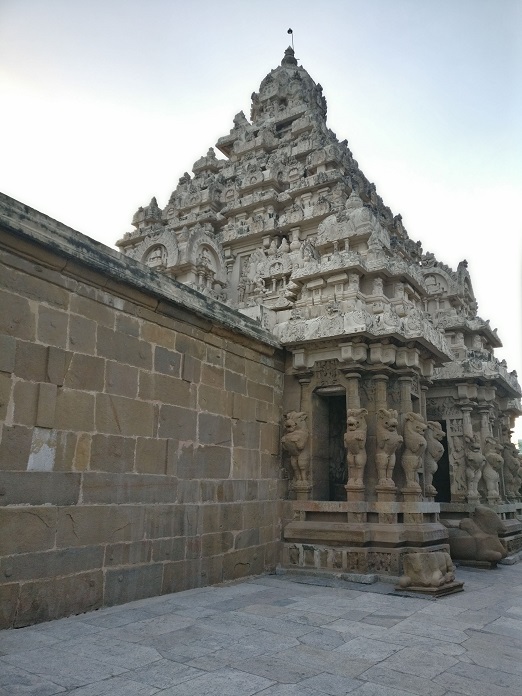
As mentioned in my previous entry about the trip to the Kailasanathar Temple, Kanchipuram warrants multiple trips given the number of Pallava and Chola era temples that should be in anyone's itinerary. In this trip, I visited the Vaikunta Perumal temple and the Ekambareswarar temple along with a couple of smaller temples. In this post, I will cover the Vaikunta Perumal temple. One thing to note about the Kanchi Pallava temples is that they are made of sandstone unlike Mamallapuram where the Pallavas used granite. Sandstone being a much softer stone, the sculptures and temple structures from the Pallava period really show their age.

The Vaikunta Perumal temple is from the 8th century built during the reign of the Pallava king Nandivarman II. Nandivarman is from a parallel line of the ruling Pallavas, a descendant of Bhimavarman, who was the brother of Pallava king Simhavishnu. After Paramesvaravarman II's death in 729, there was a succession conflict since Paramesvaran did not have a heir who could ascend the throne. As per inscriptions in the Vaikunta Perumal temple, the Pallava nobles traveled to a distant land crossing mountains and water bodies to appeal to Hiranyavarman. Hiranyavarman declined to take on the Pallava throne and instead asked his sons. Interestingly enough, the elder sons also declined and the youngest son Paramesvara agreed to become king and ascended the throne at Kanchi at the age of 12 and ruled under the name Nandivarman (II) for more than 60 years.

A noteworthy feature of the temple is the three-tiered sanctum with Vishnu in a seated pose in the ground level, reclined on Adiseshan in the middle level and in a standing posture on the top tier. The middle level is accessible through a staircase, but there is no access left to the top tier. At the ground level, the shrine is surrounded by cloisters on the inner side of which is a colonnade adorned with seated lions, a typical Pallava feature. The cloister walls have a sequence of relief sculptures depicting the history of the Pallava dynasty as per the interpretation of Dr. C. Minakshi who has written a book on the temple; the following iconography is as per Dr. Chithra Madhavan's lecture where she cites this book as her primary source. In the space below the panels, inscriptions can be found below some of them describing the scene, while many others do not have inscriptions or the inscriptions have faded and we need to rely on scholar's educated guesses.


The first set of panels show the supposedly divine lineage of the Pallavas starting from Brahma, followed by Angiras, BrihaspathiBharadvaja, Drona and Ashvatthama. The panel showing Drona has a pot near his feet which is a clue to the identity as Drona is said to have been gestated in a pot. Asvatthama is shown in penance (see photo above) and there is a rather crude sculpture of what appears to be an over-sized baby to his right, who is supposedly the first Pallava king. These panels are followed by panels depicting the actual Pallava kings themselves. A typical panel shows the king on the left frame of the panel. In some cases, the coronation of the king is shown as can be seen by priests pouring sacred water on his head. The right side of the panel shows battle scenes or other events during that monarch's reign. The panel that shows Simhavishnu curiously shows another coronation on the top right side (see picture below). C. Minakshi's interpretation is that this must be Simhavishnu's brother Bhimavarman who was crowned elsewhere to head a parallel dynasty. Bhimavarman is the ancestor of Nandivarman II, as was mentioned above.
There is one mysterious spot, right after the panel showing Vishnugopa's coronation, where the space is left empty. This purportedly - again highly speculative - shows the invasion and defeat of the Pallava kingdom by Samudragupta from the North. Samudragupta's inscriptions in the Allahabad pillar do mention his victory over Vishnugopa of Kanchi. The panels of Mahendravarman and Narasimhavarman show the battles with Pulakesin II of the Vatapi Chalukyas. Finally, we have the panels that show the search and the finding of a successor after Paramesvaravarman II's early death described earlier.
The panels in the ground tier are thus of interest from a historic perspective and less from an artistic perspective. The patchwork done by Architecture Survey of India (ASI) is at times rather crude. For artistic merit, perhaps the sculpture on the outer wall of the shrine in the middle tier are better examples. They mostly depict the avatars of Vishnu, notably Narasimha, Krishna and Vamana. These include a damaged but very rarely depicted scene of Vishnu as Mohini distributing nectar to the devas. The sculpture might be in ruins, but you still can't help but notice the beautifully delicate stance of Mohini.

- Balaji

Wednesday, March 13, 2019

The Amaravathi Gallery at the Chennai Museum

I had been to the Bronze Gallery at the Chennai museum two years ago and written about the remarkable Chola bronzes and their iconography as explained by the erudite Chithra Madhavan. Last week, I was in the company of my friend of comparable scholarship on the Amaravathi Gallery at the same museum. He has given a nearly 2 hour lecture on the history and artistic merit of the limestone sculptures at this gallery.

The Amaravathi we are talking about is an ancient town dating from the 2nd century BC, located 35km from Guntur. You might know that the Andhra government is now building a new capital city of the same name near this town. One of the great Buddhist stupas (called Mahachaityas) was built in Amaravathi over a 400 year period spanning 2nd century BCE to 2nd century CE. In 1797, the ruins of the stupa was discovered by the East India Company's Colin Mackenzie who later returned to excavate and also arranged for the limestone slabs bearing the Buddhist sculptures to be moved to the Madras Museum.

So that is what you see in the Amaravathi Gallery, a big air-conditioned hall containing a sizable collection of relief - rectangular slabs and circular panels called medallions - and other sculptures. Many of the sculptures depict stories and scenes from the Jataka Tales and others portray events in the life of Buddha. The sculptural composition might seem chaotic to an untrained eye, but starts making magical sense, when an expert describes the story behind and delineates the various sections of the panel that are sequenced chronologically, often from bottom to top. To take a simpler example, the medallion to the right shows one of the miracles performed by Buddha where he tames Nalagiri, an elephant that was sent to kill him. The left part of the panel is the first frame where you see the elephant charging, frightening people running helter skelter with maidens looking on from their windows on top. On the right, you see the subdued elephant in front of Buddha who you see in the far right.

The Jataka Tales are stories of previous births of Buddha as Bodhisatvas, in some of which he is born as an animal. The fascinating story of Chaddanta, the 6 tusked elephant is shown in one of the more complex panels. Chaddanta had two wives, Culasubhadda and Mahasubhadda. Culasubbha felt Chaddanta had a preference for Mahasubhadda and leaves him ( the bottom of the panel shows her moving away and the other two elephants show Chaddanta and his other wife) and is reborn as queen Subhadda . Chaddanta is still alive and she sends a hunter to kill him and get his tusks. Chaddanta charges the hunter, but seeing his saffron robes stops and learns his intent. The noble beyond belief Chaddanta then offers to have his tusks cut. But since the hunter could not do it, Chaddanta cuts the tusks using its own trunk, gives them to him and dies. When Subhadda looks at the tusks the hunter brings back, she realizes her folly and dies repenting her deeds.

Perhaps the most stunning panel at the gallery is the one depicting the ascension of Buddha's begging bowl to heaven. A man who has renounced everything has few possessions and you can imagine the reverence that Buddhists have for the begging bowl he used. You see a total of 43 human figures surrounding and lifting up the bowl. The composition is unique, where you see the back of some of the figures which is quite unconventional. Everyone's body and face seem to be turned towards the central figure - the bowl - which is placed off center as it is higher up closer to heaven.

The sculptures of Amaravati are unique in the use of limestone and they are reminiscent of European sculptures made of similarly colored white marble (although limestone is not quite marble). We see granite and sandstone in most Indian temples. My friend tells me that these are probably the oldest surviving stone sculptures from the historic period in South India. After visiting many Hindu monuments in the last few years, it was nice to see these great examples of Buddhist art and to hear the stories they tell.

- Balaji

Sunday, February 10, 2019

Some books I liked

I have been on a reading spree the last few months, now that I have some time in my hands. Thought I would share the noteworthy ones (putting my 1-5* rating, with 5 being the best).

To be followed hopefully soon by another post on non-fiction.

Scott Turow - Presumed Innocent (4.5*)
A legal drama/murder mystery with heavy emphasis on the former. Really high quality writing and arguably among the all time greats as crime/legal dramas go. Works well at multiple levels; a public prosecutor is indicted for murder of a woman who he has had an affair with. Turow focuses with poignant empathy, the anguish the prosecutor and his family go through as the trial progresses. Not to mention the fact that it is a well crafted murder mystery.  Will say no more. Read to find out why.

John Le-Carre A Most Wanted Man (4.5*), The Mission Song (4.0*)
John Le Carre writes authentic spy novels with British Intelligence protagonists. Over the years, like many spy novelists, Le Carre  has moved on from MI6 butting heads with the KGB and the Russians to combating middle-eastern terrorists in his later novels. I have always liked his writing style. His narrative moves at a velocity that is Pujara-like than say Sehwag, but his recent novels are a bit more pacy. His writing has a lot of humanity (or bleeding heart sentimentality depending on your perspective). His protagonists are extremely noble, often naive, trying to do the right thing fighting domestic obstacles - such as the doddering British bureaucracy and outright moral corruption of politicians - more than the actual villains.  Among the many I read recently (Our kind of traitor, A Most wanted man, Our Game and now reading The Delicate Truth), I highly recommend A Most Wanted Man which captures this fine author at his best. A Most Wanted Man has also been made into a critically acclaimed movie. The other book I liked is The Mission Song.

Daniel Silva (Gabriel Allon series) (3.0-4.0*)
I read every Gabriel Allon the Israeli agent book except the latest one. It was the reading equivalent of binge-watching a TV show. If you have a (grudging or otherwise) respect for Mossad as a highly effective Intelligence Service, you might enjoy sampling this series. I would not recommend reading the entire series like I did; it does get repetitive with a certain plot and story structure that almost all the novels have. However I found the characters likable, especially the middle aged hero Gabriel Allon, complete with supreme ability at what he does, a tormented past and the works and Ari Shamron, his petulant boss, also once a super agent.

Daniel Silva - An Unlikely Spy (4.0*)
A good old-fashioned spy vs. spy yarn set in the second world war where British and German Intelligence agencies are engaged in endless deception and counter deception as to the time and location of the allied invasion of France.

I also read Ken Follett's Triple (3.5*) (another Israel vs. Enemies spy novel) and Jackdaws. Triple is not bad, but nowhere close to Ken Follett's best novels (such as Eye of the Needle). Jackdaws is below average (2.75*) and can be given a miss.

I dusted up my copy of Nancy Pearl's More Book Lust to find some recommendations when I was running out of ideas. In addition to leading to Scott Turow's Presumed Innocent, Nancy led me to some non-English authors:

Batya Gur (Murder in Jerusalem) (4.0*)
High marks for this taut murder mystery set in a Television Station in Jeruasalem, where the tension seems to never let up. You get this feeling that this is how Israelis actually live, in constant tension. Not a book to read if you're looking to relieve some stress.

Henning Mankell (original Swedish - Firewall) (3.75*)
A solid police procedural starring Kurt Wallander who features in a number of Mankell's books. True to a vaguely melancholic atmosphere I associate with all places up in the temperate/Arctic zone, Wallander seems to be battling inner demons and has a miserable personal life while solving crime.

- Balaji


Saturday, February 9, 2019

Trip to Manali (via Chandigarh)


One of  my resolutions when I returned to India was to travel all over the country. It is more than 10 years now since we returned and we have hardly averaged a trip every year. Noteworthy trips to places of culture and history include Hampi, Ajanta & Ellora, Mahabalipuram and Tanjore. I wrote about the Hampi trip earlier in this blog. As for places of nature there is a lot to cover. This summer, we decided on Manali. After looking at the exorbitant flight tickets that take us close to Manali (Kullu), we decided to fly to Chandigarh and drive the 300km to Manali.

We had heard about how organized a city Chandigarh is, and it did live up to its reputation. In addition to the grid layout of the streets, what was remarkable was the homogeneity of the architecture. The streets were lined with long red brick buildings, which housed all the shops and retail outlets. While one might argue this is rather boring, it was part and parcel of the infrastructure that included paved walkways and curbed roads, things that are sorely missed in Indian metros. And the food was great, wholesome Punjabi (and Haryanvi?) food at its authentic best.

We made the last minute decision to cancel the self-drive rental and booked an Innova with savaari.com to get to Manali. This ended up being a smart decision, as the drive was a grueling 10 hour bumpathon on middling to terrible roads. There is work happening to widen the road which meant that the roads were in worse condition than usual as we waded through work crews chipping away at the mountain side to create room for the wider road. In the last 60 km however, the Kullu valley's beauty recharged our tired bodies.  Our driver knew all the good eateries along the way and we enjoyed real Malai Kofta and rotis doused in white butter.

The Club Mahindra resort (White Meadows) did live up to its premium designation with big rooms that were luxuriously appointed.

This being early in summer, the road to Rohtang pass had not thawed out yet and we were allowed only up to the scenic Solang valley which is another 15 km up the mountain. A pony ride took us up to a point where we could hang out in the rocks and the rollicking snow-melt. The snow itself was elusive, a good 200 ft further up. On the drive back from Solang valley, we stopped at a point, where we could go sit on the rocks by the river. Sitting on a rock and putting your feet into a gushing river in the mountains has got to be one of the defining pleasures on planet earth. Missing out on Rohtang Pass was a disappointment; I guess you will have to travel after May if you want to get up there.

On the way back from Manali, my wife and daughter decided to brave the rains and went river rafting on the Beas and had a rollicking good time.


- Balaji

Thursday, November 8, 2018

Trip to Kanchipuram - Kailasanathar Temple

We traveled to Kanchipuram on a day trip from Chennai. I was lucky to have my friend who is a learned historian, well versed in Pallava architecture and iconography. To warm things up, we went to a couple of smaller temples first (Mukteswara temple, Pravalavarna Swamy Temple) before lunch at Hotel Sakthi Ganapathy, followed by a 3 hour stop at the highlight of the visit - the Kailasanathar Temple.

Kanchipuram can stake a claim to be the temple capital of South India, if not all of India. The Pallavas ruled from here during the 6th, 7th and 8th centuries CE and have commissioned temples of breathtaking majesty, whose sculptural  and architectural excellence make them in my humble opinion on par with that dynasty's efforts at Mamallapuram.  UNESCO which bestowed World Heritage Site status to Mamallapuram, for some reason has given the Kanchipuram temples a miss. 


The Kailasanathar temple was commissioned by Rajasimha Pallava who is also credited with the Shore Temple at Mamallapuram. The vimanam (structure on top of the inner sanctum) is reminiscent of the Mamallapuram Shore Temple although much bigger. The vimanam and most of the superstructure is built of sandstone on a granite base. The Vijayanagar kings are said to have added the granite mandapam (hall) that connects the main temple to the original Pallava mandapam. I think they did a disservice which among other things, robs one off a more complete view of the beautiful main temple.

The temple is structural in the sense that it is made of a stack of sandstones, with the sculptures spanning and aligned across multiple stone pieces. See adjoining picture of Dakshinamurthy where you can see the crease line between the stones along the forehead of the elephant and along Dakshinamurthy's waist.

The unique architectural feature of the temple is the surrounding structure which is made up of 58 sub-shrines with exquisite sculptures both inside and between them. The sculptures depict Lord Shiva in his many forms, along with other figures of the Hindu Pantheon playing out scenes of stories from the puranas and other Hindu texts:

Gangadhara, where Shiva gathers the river Ganges with a strand of his hair. Parvathi in a twisted pose seems to be looking with a touch of envy.

Dakshinamurthy under a banyan tree surrounded by peaceful lions, deer and the rishis receiving his silent intonation of the vedas.

Dancing as Urdhwa Tandava where he is raising one of his legs almost vertically up to replace his fallen ear rings (kundalam) without missing a step (there is a legend that Shiva and Parvati were dancing in competition and Parvati could not match this particular move, understandably so, owing to her modesty). This pose is the second most common pose of Shiva dancing in Pallava and Chola art, with Nataraja being of course the more common and well known.

Lingodbhava, where Vishnu and Brahma are trying in vain to find Shiva's feet and head respectively.

Kalantaka, where Shiva is rescuing his devotee Markandeya from Lord Yama.

Kirata & Arjuna showing Arjuna and Lord Shiva as Kirata the hunter dueling before Shiva grants Arjuna his astras for the Mahabharata war.

In addition to Shiva, Vishnu also figures in some of the sculptures, the most common form depicted being the Narasimha.

There are Tamil inscriptions (in the Grantha script) along the bottom of the sculptures citing the many titles Rajasimha presumably bestowed upon himself  including ironically Guna Vineetha  - the humble one. There are two layers of inscriptions the bottom one a beautiful calligraphic version (see picture).

In the niches between the subshrines you see Somaskandhas - Shiva, Parvati seated with Karthikeya as a child between them and also a couple which is likely to be Rajasimha and his queen or Siva and Parvati. The case for the former is strengthened by the fact that the couple don't have their hands in the abhaya (blessing) mudra.

It should be noted that the iconography is not always obvious and the two experts who I was with sometimes had different interpretations of some of the sculptures. One such sculpture is remarkable for the dynamism in the poses of the figures is (arguably) a scene where Indra is trying to enter Kailasha but is stopped by a Gana*. There is something unique about this Gana, who is bigger and standing on a lotus which should have given Indra a clue. Indra, angered by the rebuff is about to deploy his Vajrayudha, while Brahma is desperately trying to stop him, having realized that the Gana is none other than Shiva himself.

I reached information overload and we had finished only two sides of the outer sub-shrine lined structure. After coffee and snacks at Saravana Bhavan, we made a quick stop at the Pandava Thoothar Perumal Temple that houses a gigantic form of Lord Krishna. He assumed this when Duryodhana tried to humiliate him when he came to visit as the Pandavas' messenger trying to stop the war. The bigger black statue is actually behind the Utsava Murthy (idol used during processions) in the inner sanctum.

It would take at least a week to do justice to all the major temples of Kanchipuram. We looked at the majestic gopuram of Ekambareswarar Temple from the distance. Not to mention Vaikunta Perumal, Kamakshi Amman, Ulagalantha Perumal to round out the top 5.

- Balaji


* Gana's are Shiva's attendants in Kailasha who are often portrayed as dancing, sometimes with musical instruments. They are also gatekeepers and are notorious for their protectiveness of Shiva's valuable time.

Saturday, March 17, 2018

Thousand paper cuts

I have been meaning to write about the small irritants that we face every day as we commute back and forth to work and live our daily lives in ever more crowded metropolises. A lot of them, I realize, are avoidable, but we inflict them upon ourselves. They are community or government imposed restraints or misguided mitigations that could have been avoided in the first place if everyone followed rules and played nice. The problem with this is that the behaviors of the minority who are rule violators cause everyone to pay a penalty.

I will start with the ubiquitous speed breaker. When our residential community was built 8 years ago, we didn't have any speed breakers. After noticing how fast people were driving inside the community even after repeated exhortations, the community decided to put in speed breakers. This is a localized example of a phenomenon we see everywhere on public roads. Because people speed, the authorities think speed breakers are the only way to slow them down thereby penalizing drivers that drive responsibly with harsh thuds that cause just a tiny amount of degenerative change in your backbone every time. This I am sure has caused totally unintended consequences. People believe they can speed as much as they want until they are signaled by their authorities to slow down through the presence of a speed breaker. The effect of such speed breakers and the ever present potholes on Indian roads have caused car makers to build vehicles with higher and higher road clearance and often advertise it as a great feature.

I don't know why we need to ride or drive with high beam inside the city where there is plenty of ambient light. I am continuously blinded by them and I am sure I am not the only one who cannot see a pedestrian wearing dark clothes to the left of the oncoming car until the last desperate moment. I have tried playing traffic vigilante, flashing my lights at the oncoming car. One in ten cars get the hint and dim their lights perfunctorily. The authorities not only seem to ignore this problem, they actually accommodate for it; they build partitions between the two sides of the road and increased the height just enough to hide the headlights of cars coming from the opposing side. Car manufacturers have tried to mitigate the problem by manual or auto-dimmers in rear view mirrors.

This problem with high beams had an interesting ripple effect in my community. The security guards at the gates of my community like to look at the driver of an approaching car to see if it is a known inhabitant or a visitor and act accordingly. With the high beam this is simply impossible, so they decided to fight light pollution with more light pollution. They worked with the community officials to install bright LED lights facing the oncoming cars. This meant that the security area is lit up like a studio throughout the night; light that seeps into neighboring houses including mine.

I can go on. I see a similar phenomenon with security (either cyber or physical security), wherein in the name of security we have added inconvenience after inconvenience and we numbed ourselves to them as the new normal; my favorite example is flying in an airplane. This is a bit more controversial and a topic for another day.

R. Balaji

On cars, SUVs and electrification

 I have been a car buff ever since I move to the US in the early 90s and have been closely following the market in the US. After moving back...